Can a Business Coach Help You Become a Better Leader?
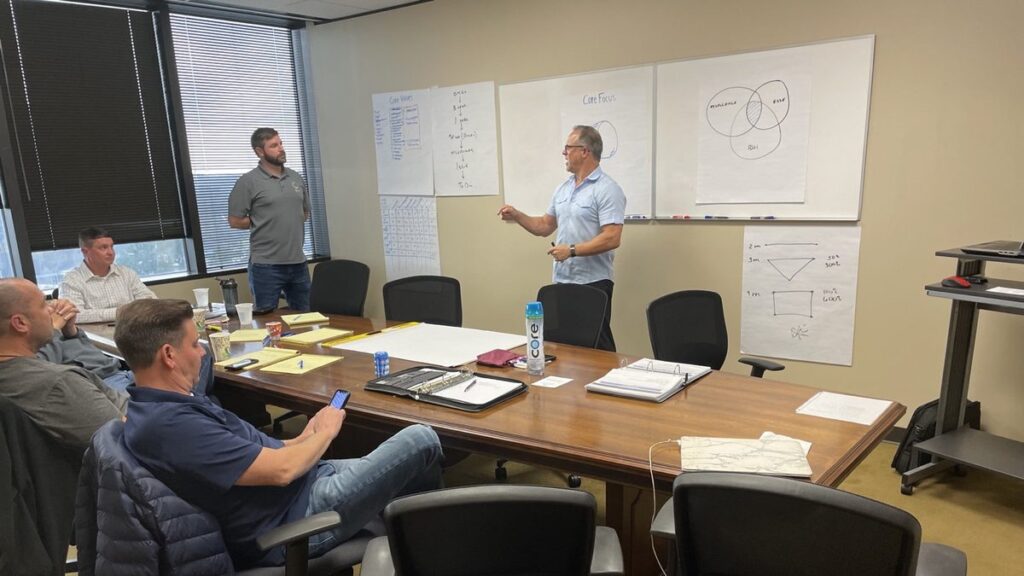
Growth doesn’t just test your business. It tests you.
Every owner who’s scaled past the first few million has felt it: the skills that got you here stop being enough to get you to the next level. You didn’t get worse at leading. The job got bigger. More people, more decisions, more distance between you and the work that’s actually happening — and nobody handed you a manual for that transition. A business coach’s real job isn’t to hand you generic leadership tips. It’s to help you become the leader your company needs right now, at the size it actually is, not the size it was when you started.
The leadership gap is usually invisible from the inside.
Most owners can point to their revenue numbers, their headcount, their pipeline. Almost none of them can point precisely to where their own leadership is quietly capping the business — because you’re inside it. You feel the symptoms (a team that won’t move without you, decisions that stall, good people who seem to have checked out) without always connecting them back to the source. A $20M business we’ve watched go through this had every operational piece in place — solid product, real demand — and was still stuck, because the owner was leading the way he’d led at $5M. The fix wasn’t a new system. It was the owner.
Three places it shows up, over and over.
- You’re still the answer desk. Every hard call still routes to you, not because your team can’t handle it, but because they’ve never been trusted to.
- Your team can’t read your mind, so they wait. If people don’t know exactly where you’re headed and why, they default to asking instead of deciding — every time.
- You’re managing tasks instead of developing people. The leader who got the company to $10M is often still doing the job of a $2M manager: checking work instead of building leaders who can check their own.
None of these are character flaws. They’re the natural output of a business that outgrew the leadership style that built it — and they’re exactly what a good coach is trained to see and name.
It’s not motivational talk. It’s structural work on how you lead.
A real coaching relationship isn’t a pep talk every other Tuesday. It’s disciplined work on the handful of things that actually change how a leader operates: get brutally clear on where the business is going so your team can decide without you; build the habits and cadence that let you delegate real ownership, not just tasks; and develop the self-awareness to see your own blind spots before they cost you a key player or a stalled quarter. Good coaching also holds up a mirror most owners never get otherwise — someone with no stake in flattering you, whose only job is telling you the truth about your leadership.
A stronger leader builds a company that doesn’t need to be rescued by its owner.
When you grow as a leader, the effect isn’t just “you feel better about how you’re leading.” It’s structural. Decisions move faster because people trust the direction and their own authority to act on it. Good people stay, because they’re being led, not managed. And you get distance from the day-to-day without the business falling over the second you step back — which is usually the actual thing owners are chasing when they say they want to “grow.”
Find out which side of your leadership is actually the constraint.
Leadership gaps almost always show up on the Dynamic side of the business — the trust, communication, and accountability that either holds a team together or quietly erodes it. But sometimes what looks like a leadership problem is really a missing Direction (nobody knows where you’re headed) or a Design gap (no system for anyone else to lead within).
The 3D Self-Diagnostic scores all three sides of your business, one to ten, in about ten minutes — free, no strings — and shows you exactly where to start.
Take the 3D Self-Diagnostic. Or, if you’d rather talk it through with a coach who’s actually led a company through this stage, book a call.